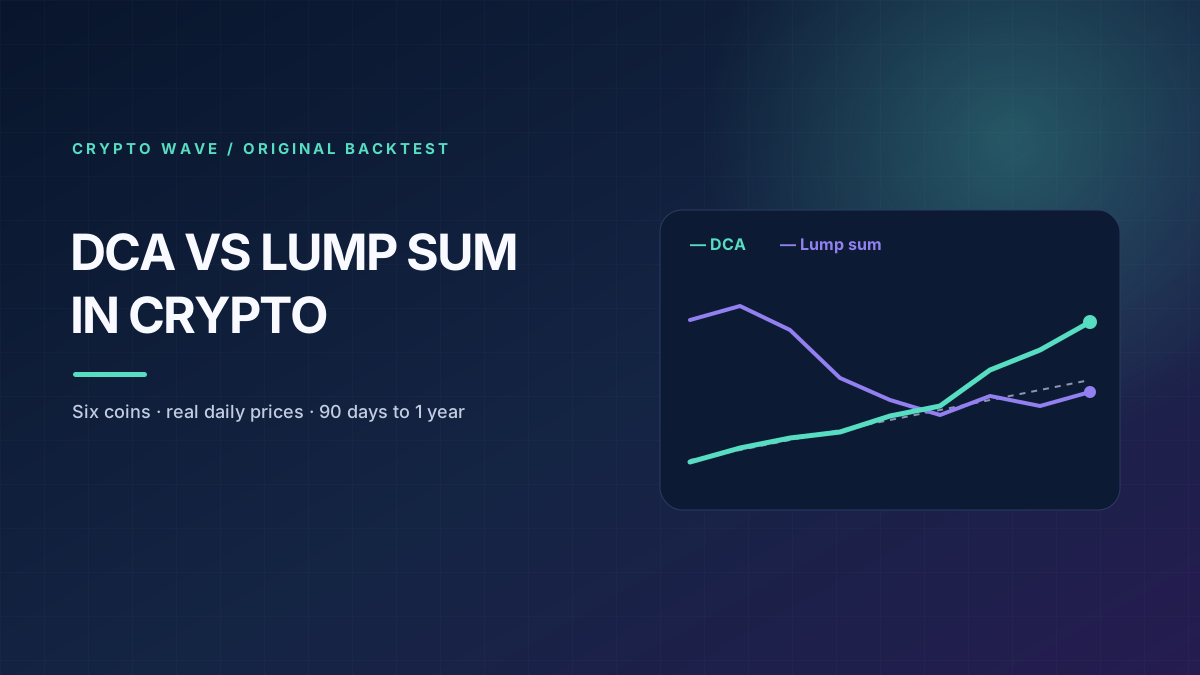
If you have money to put into crypto, you have two basic choices: invest it all at once (a lump sum), or split it into equal buys on a schedule, known as dollar-cost averaging or DCA. Most articles answer the "which is better?" question with theory. We ran the numbers instead.
Using real daily closing prices, we backtested a simple plan on six of the largest cryptocurrencies: $50 every week, with a 0.1% trading fee on every buy, compared against investing the same total on the first day. We looked at three periods ending on October 5, 2026: the past year, the past six months and the past three months. You can rerun any of these yourself, with your own amounts and coins, in the CryptoWave DCA backtester.
Key takeaways
- Over the past year, DCA beat a lump sum on all six coins, often by a wide margin. A lump sum lost between 30% and 62%; weekly DCA was positive on five of the six.
- Over the past 90 days, the result flipped: a lump sum won on every coin, because prices rose steadily from the start of that window.
- The deciding factor isn't the method. It's what the price does after you start. DCA protects you when prices fall first; a lump sum rewards you when they rise first.
- DCA's biggest practical advantage is a smaller worst-case drawdown, which makes a plan easier to stick with.
How DCA and lump-sum investing work
With a lump sum, all of your money buys at one price. Your result depends entirely on where that single entry price sits relative to where the market goes next.
With dollar-cost averaging, a fixed dollar amount buys more coins when the price is low and fewer when it's high. Your average cost per coin ends up lower than the simple average of the prices on your buy days. The trade-off is that part of your money sits on the sidelines while you wait to invest it, so in a rising market DCA buys at higher and higher prices.
A simple example: you invest $100 a week for two weeks. In week one the price is $50, so you get 2 coins. In week two it's $25, so you get 4 coins. You've spent $200 for 6 coins, an average cost of $33.33, even though the average price was $37.50.
Our backtest: $50 a week vs. investing it all on day one
The method was the same for every coin. Each buy spends $50 minus a 0.1% fee at that day's closing price. The lump sum invests the same total amount on the first day of the period, also minus 0.1%. Values are measured at the October 5, 2026 close. Prices come from CoinGecko's daily data.
Past year (Oct 2025 – Oct 2026): DCA won everywhere
| Coin | Price a year ago | Price now | DCA return | Lump-sum return | DCA avg. cost |
|---|---|---|---|---|---|
| Bitcoin (BTC) | $123,489 | $86,246 | +11.5% | −30.2% | $77,345 |
| Ethereum (ETH) | $4,513 | $2,724 | +15.8% | −39.7% | $2,353 |
| Solana (SOL) | $228.52 | $121.64 | +23.6% | −46.8% | $98.40 |
| BNB | $1,167.60 | $791.93 | +10.9% | −32.2% | $713.92 |
| XRP | $2.97 | $1.52 | +2.2% | −48.8% | $1.49 |
| Dogecoin (DOGE) | $0.2528 | $0.0966 | −5.7% | −61.8% | $0.1024 |
Every coin in our sample finished the year well below where it started, but with a deep dip somewhere in between. That shape is where DCA shines. Weekly buys kept accumulating coins at the lows, pulling the average cost far below the starting price. Someone who put $2,650 into Solana on day one would have about $1,409 today. Someone who spread the same $2,650 across 53 weekly buys would have about $3,276.
Notice Dogecoin, though. Even with DCA, the plan lost money, because the price ended below the DCA average cost. DCA reduces timing risk; it can't rescue an asset that keeps falling.
Past six months: roughly a draw
| Coin | DCA return | Lump-sum return | Winner |
|---|---|---|---|
| Bitcoin | +22.1% | +22.0% | Tie |
| Ethereum | +31.6% | +24.8% | DCA |
| Solana | +46.0% | +47.2% | Lump sum (barely) |
| BNB | +25.6% | +31.7% | Lump sum |
| XRP | +22.8% | +13.2% | DCA |
| Dogecoin | +13.8% | +4.3% | DCA |
Starting six months ago, prices first drifted lower and then recovered. The two methods ended close together, with DCA ahead on three coins and the lump sum ahead on two.
Past 90 days: lump sum won every time
| Coin | DCA return | Lump-sum return |
|---|---|---|
| Bitcoin | +21.9% | +36.0% |
| Ethereum | +27.7% | +53.6% |
| Solana | +38.8% | +50.8% |
| BNB | +22.6% | +37.2% |
| XRP | +25.7% | +36.7% |
| Dogecoin | +22.7% | +30.1% |
Three months ago, prices were near a low and climbed from there. Every weekly buy after the first was more expensive than the one before, so the lump sum, fully invested at the bottom, came out ahead on all six coins.
What the numbers actually tell you
Put the three periods side by side and a pattern appears: the winner depends on the price path, not the method. When the market falls after you start, DCA wins, sometimes dramatically. When the market rises after you start, a lump sum wins. When it chops around, they end up close.
Studies of stock markets often find that a lump sum beats DCA roughly two-thirds of the time, simply because markets have historically risen more often than they've fallen. Crypto is far more volatile, and as our one-year results show, a single bad entry point can cost a lump-sum investor 30% to 60% in a year. That volatility is exactly what makes DCA appealing for crypto.
The drawdown factor: why DCA is easier to live with
Final returns aren't the whole story. We also measured each plan's maximum drawdown, the largest drop from a previous high in portfolio value. Over the past year, weekly DCA had a worst drawdown of 24% on Bitcoin, 35% on Ethereum and 33% on Solana. Those are painful, but because new buys kept arriving, the portfolio recovered as soon as prices did.
A lump-sum investor who bought Solana a year ago, by contrast, spent most of the year sitting on a large loss. Many people sell at exactly that point. A strategy you can stick with through a downturn usually beats a theoretically better one you abandon halfway.
When DCA makes sense, and when a lump sum might
DCA tends to suit you if:
- You're investing from regular income rather than a one-off amount.
- You're new to crypto and want to avoid the regret of buying everything at a peak.
- Prices have already risen sharply and you're worried about buying the top.
- You know a big drop would tempt you to sell.
A lump sum may suit you if:
- You have a long time horizon and can genuinely ignore short-term swings.
- Prices have already fallen a long way and you're comfortable with the risk that they fall further.
- Fees make many small buys expensive (see below).
Many people split the difference: invest part immediately and DCA the rest over a few months.
Fees can quietly decide the result
Our backtest used a 0.1% fee per buy, typical for a low-cost exchange. Some apps and "instant buy" buttons charge 1.5% or more, often as a spread you don't see. On 53 weekly buys of $50, a 0.1% fee costs about $2.65 in total. At 1.5% it's about $40, which would have wiped out most of XRP's one-year DCA gain. Before you set up a recurring buy, check the real cost, including the spread. Our guide to exchange fees, maker/taker and spreads explains what to look for.
How to set up a simple DCA plan
- Pick an amount you won't need. Choose a weekly or monthly figure you can keep investing even if prices halve.
- Choose a low-cost platform. Compare trading fees and spreads, and check the exchange is active and reputable on our exchange status checker.
- Automate it. Most major exchanges offer recurring buys. Automation removes the temptation to skip a week when the news is scary.
- Decide where the coins will live. For long-term holdings, consider moving them to a wallet you control. See hot vs cold wallets.
- Review, don't react. Check your plan every few months, not every day. Track it with a watchlist and portfolio tracker.
Frequently asked questions
Is DCA better than a lump sum for crypto?
Neither always wins. In our backtest, DCA beat a lump sum on all six coins over the past year because prices fell after the start, while a lump sum won on all six over the past 90 days because prices rose. DCA mainly reduces the risk of a badly timed entry.
How often should I DCA into Bitcoin?
Weekly and monthly are both common. Over long periods, the frequency matters much less than consistency and fees. Buying more often with a high per-trade fee can cost more than it gains.
Can you lose money with DCA?
Yes. If the price ends below your average cost, you lose money. In our test, weekly DCA into Dogecoin over the past year ended down 5.7%. DCA reduces timing risk but doesn't remove market risk.
What is a good amount to DCA?
An amount you could keep investing for a year or more even if prices dropped by half, and that you won't need for living costs. There's no minimum that makes the method work; consistency does.
This article is for education only and is not financial advice. Backtests use historical prices and don't predict future returns. Results exclude taxes and withdrawal fees. Figures are based on daily closes from October 6, 2025 to October 5, 2026.