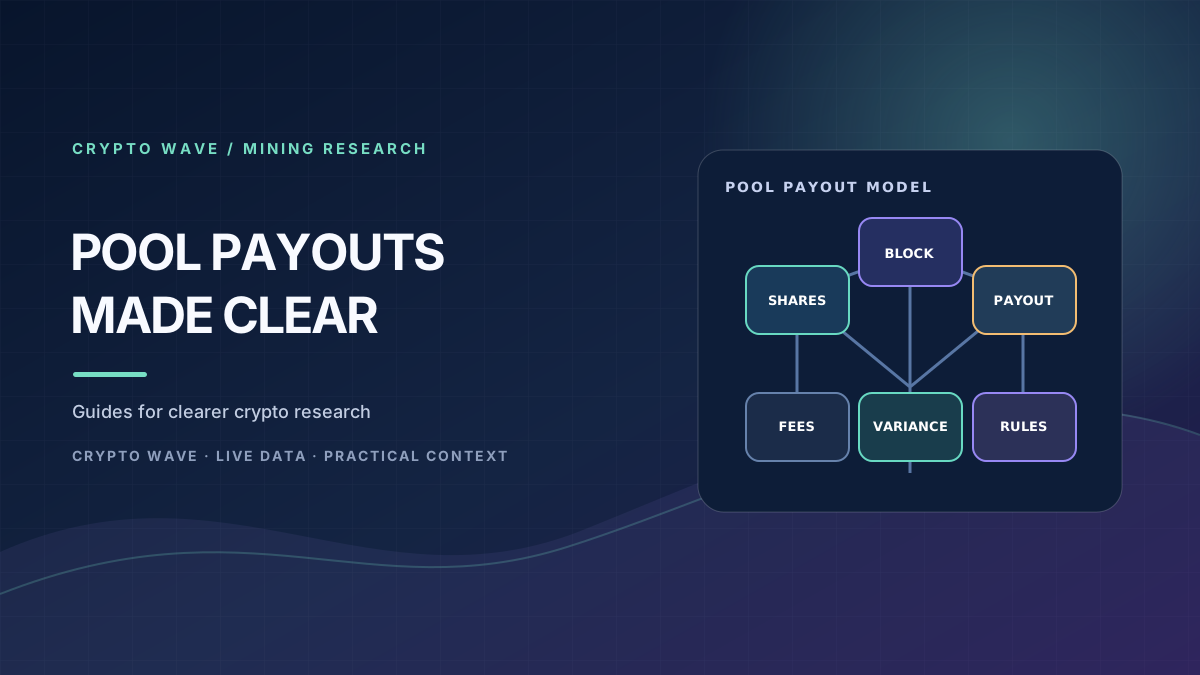
Choosing a mining pool is an operational decision, not simply a search for the lowest advertised fee. A pool connects miners to a payout system, a server network, a block template process and a dashboard that must remain available when conditions change. The right choice depends on the asset, algorithm, hardware, location, electricity cost and the level of variance a miner can tolerate.
Key takeaways
- Match the pool to your coin, algorithm and hardware before comparing fees.
- Payout models (PPS, FPPS, PPLNS) change how much variance you carry; read the exact formula.
- Total cost includes withdrawal fees and minimum payouts, not just the headline pool fee.
- Measure your own stale and rejected shares after connecting; latency matters.
Mining pool directories make it easier to build a shortlist, but a listing should be the beginning of research. Fees, minimum payouts, supported coins and server locations can change. Check the pool’s current documentation and status page before pointing production hardware at it.
Start with the algorithm and asset
A pool must support the algorithm used by your hardware and the network you intend to mine. Some pools focus on a single asset, while others support several coins or offer merged mining. Confirm that the pool is currently accepting shares for the exact coin and algorithm rather than relying on an old search result.
Also check whether the pool supports your hardware and software configuration. Stratum endpoints, TLS support, worker naming and failover instructions affect the reliability of a deployment. A pool that looks attractive on paper is not useful if your firmware cannot connect consistently or if the recommended port is blocked by your network.
Understand payout models
PPS, FPPS, PPLNS, PROP and solo models distribute variance differently. Pay-per-share models generally offer a more predictable payout for valid shares, with the pool taking on more of the block-finding variance. Full pay-per-share models may include a portion of transaction fees according to the pool’s rules. Pay-per-last-N-shares models tie rewards more closely to recent contribution and can fluctuate as blocks are found.
Solo mining has the highest variance. A miner can find a block and receive the reward according to the pool arrangement, or receive nothing for a long period. That may be appropriate for a specific risk preference or a small lottery-style allocation, but it should not be confused with predictable cash flow. Read the exact payout formula, not just the acronym.
Compare the total fee
The advertised pool fee is only one part of the cost. Look for withdrawal fees, transaction fee treatment, merged-mining rules, payment processing charges and any minimum balance required for automatic payouts. A pool with a slightly higher visible fee may have better connectivity, clearer accounting or lower withdrawal friction.
Estimate how often your expected balance will cross the minimum payout. A very high minimum can leave small miners waiting for months, while a very low threshold can produce more on-chain transactions and fees. Use conservative assumptions about network rewards and coin prices because a payout estimate is not a guarantee.
Server location and latency matter
Mining work is time-sensitive. Choose an endpoint geographically close to your hardware when possible, then measure stale or rejected share rates after connecting. A pool may list several regions, but the best region is the one that delivers stable performance from your actual network.
Set a backup server from the pool’s official failover list and test it. Multiple endpoints from one provider may not protect against an account or pool-wide outage, so some operators maintain a secondary pool as well. Keep the failover order documented and monitor whether hardware is silently mining on a less profitable or unsupported endpoint.
Review transparency and operations
Look for clear documentation, public pool statistics, payout history and a responsive status page. A credible pool should explain how shares are counted, when balances are paid, how orphaned blocks are handled and how users can contact support. Public dashboards do not prove solvency or future uptime, but missing information makes independent verification harder.
Check the age of the domain, the reputation of the operator and the consistency of announcements. Be cautious when a pool promises guaranteed profitability or asks for unusual wallet permissions. Mining pools should not need your private key or recovery phrase. Use a dedicated payout address and confirm the address in the pool account before directing meaningful rewards.
Measure your own results
After connecting, record hashrate, accepted shares, rejected shares, stale shares, uptime, payout amount and payout timing. Compare the observed result with the pool’s estimate over a long enough period to account for normal variance. A few hours may be too short to judge a payout model, especially for small hashrates or solo arrangements.
Electricity cost remains the largest variable for many operations. Use a realistic power rate, hardware efficiency, cooling cost and downtime assumption. A pool change cannot make an unprofitable machine profitable by itself. Likewise, a coin with a higher displayed reward may have lower liquidity, higher difficulty or greater market risk.
Worked example: comparing two pools
Suppose your miner earns about $10.00 a day in gross rewards. Pool A charges 2.5% on FPPS, which includes transaction fees, and pays out daily above a 0.005 BTC minimum. Pool B charges 1.0% on PPLNS, which excludes transaction fees from the payout calculation and pays above 0.01 BTC.
On paper Pool B is $0.15 a day cheaper. But if transaction fees add 4% to block rewards, FPPS adds around $0.40 a day that PPLNS doesn't pass on in the same way, and PPLNS payouts will swing above and below the average. Pool A also pays twice as often for a small miner. The cheaper headline fee isn't automatically the better deal; run your own figures in the mining profitability calculator.
A mining pool comparison checklist
- Confirm the supported coin, algorithm, ports and miner software.
- Read the payout formula and understand variance.
- Compare pool fee, withdrawal fee, minimum payout and transaction fee policy.
- Select nearby servers and measure stale shares after connecting.
- Configure tested failover endpoints.
- Review uptime history, documentation, support and payout transparency.
- Track your own results and reassess after network or hardware changes.
CryptoWave mining pool pages are designed to help you organize this comparison across supported coins, payment models, locations and fees. Treat the directory as a research aid and verify live terms at the pool before making an operational change. This article is educational and is not mining profitability advice.
Reassess after every major change
Pool performance should be reviewed when network difficulty changes, a coin changes its reward policy, new hardware is installed or your internet route changes. A pool that was convenient last quarter may now have higher latency or a payout threshold that no longer fits your operation. Keep dated screenshots or exports of your hashrate and payout history so that you can compare like with like.
Do not optimize one metric in isolation. A lower fee can be outweighed by rejected shares, delayed payments or downtime. A larger pool can reduce variance but may offer less control over policy, while a smaller pool may provide a closer community and a different risk profile. The best comparison is the one that reflects your actual hardware, costs and tolerance for uncertainty rather than a generic ranking.
Frequently asked questions
What is the difference between PPS and PPLNS?
PPS (pay per share) pays a fixed amount for every valid share you submit, so income is steady and the pool carries the luck risk. PPLNS (pay per last N shares) pays only when the pool finds blocks, based on your recent shares, so income varies more but fees are often lower.
What is a good mining pool fee?
Most established pools charge between 0% and 4%, depending on the payout model. FPPS and PPS pools usually charge more because they absorb variance. Compare the total cost, including withdrawal fees and how transaction fees are shared.
Should I mine solo?
Only if you accept that you may earn nothing for a very long time. For most home miners the chance of finding a block alone is tiny. Pools exist to turn that lottery into a steady, smaller income.