Choosing a decentralized exchange is not just a matter of finding the largest name or lowest advertised fee. A DEX can mean an automated market maker (AMM), an on-chain order book, or an application that routes trades across several venues. The right comparison starts with the asset pair and network, then looks at the amount you want to trade, the quoted output, total costs, and the contracts you will authorize.
This guide replaces a dated “best DEX” ranking with a reusable way to compare venues. Features, liquidity, supported networks, and costs change over time, so verify live details before making a transaction.
Know what kind of DEX you are comparing
In an AMM, traders swap against tokens held in a liquidity pool. The pool’s pricing formula changes the relative price as the trade consumes reserves. In a concentrated-liquidity pool, liquidity can be concentrated within chosen price ranges, which affects how much depth is available at a given price. An on-chain order book instead matches buy and sell orders under its own rules.
A DEX aggregator is different: it searches liquidity across multiple pools or venues and constructs a route. A route may split a trade or use intermediate tokens. This can improve the quoted output for a particular trade, but it may add contracts, approvals, or route dependencies. Uniswap’s developer guide to how swaps, price impact, and slippage work explains AMM execution as one example.
Compare the full execution cost
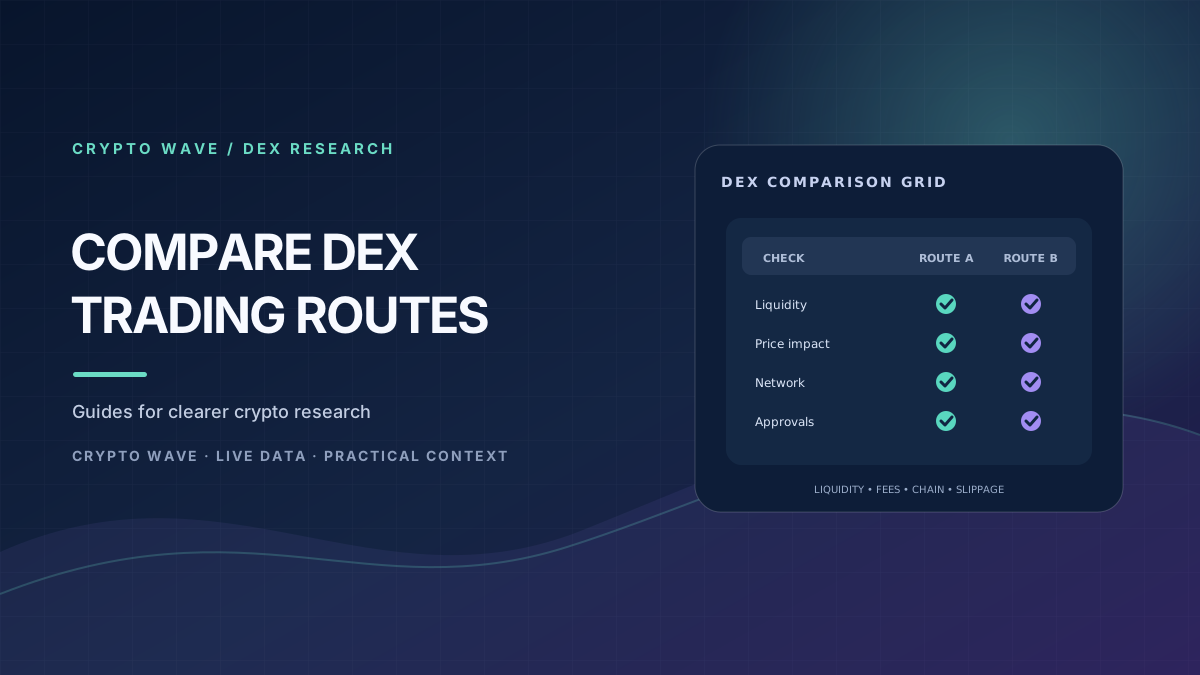
Start by comparing the same input amount, output token, network, and approximate time. Look at the estimated amount received after trading fees, routing fees, price impact, and network gas. A low pool fee does not guarantee a low-cost trade: a shallow pool may produce a worse price than another route, and a multi-hop route may pay multiple pool fees.
Price impact is the effect of your trade on the pool price. Slippage describes how execution can differ while the transaction is pending as prices and liquidity change. Slippage tolerance sets an acceptable bound; it is not a fee or a guarantee that you will receive the quoted amount. Check the minimum output and transaction deadline. If you increase tolerance to avoid a failed transaction, you may allow a less favorable fill.
Liquidity and volume need context
Liquidity is about how much can trade near a given price. A pool’s total value locked is a broad snapshot, not a quote for your trade size. Concentrated liquidity can be deep within one price range and thin outside it. Volume reports activity over a period, but can change rapidly and may be measured differently by different dashboards.
Request or inspect a quote for the amount you actually plan to trade. Compare output, price impact, pool or route, and gas. Check whether liquidity is available on the correct chain and for the exact token contract. The amount displayed for a popular token name may refer to a different contract or wrapped version than the one you intended.
Understand fees, routing and approvals
Fees can include a pool trading fee, a protocol fee where enabled, an aggregator or interface fee, and blockchain gas. Fee schedules vary by protocol version, pool, network, and trade route. Uniswap’s official fee documentation, for instance, describes differences across its protocol versions. Always inspect the current transaction quote instead of relying on an old comparison table.
Many token swaps require an approval that lets a contract spend a token from your wallet. Review which contract is receiving permission and whether the amount is limited to the trade. The Ethereum documentation for the ERC-20 token standard describes the approval and allowance functions. A wallet connection alone is different from granting a token allowance.
Check security and execution risks
DEX trades involve smart contracts, interfaces, wallet software, tokens, and the network where the transaction executes. Risks include contract bugs, upgrade or administrator permissions, malicious token contracts, phishing sites, and mistakes when signing. An audit or long operating history can provide useful information, but neither proves that a contract or token is safe.
On public blockchains, transactions may be reordered or included in ways that affect execution. Ethereum.org’s MEV documentation explains how transaction ordering can create value extraction opportunities. MEV protections, private order flow, or a swap interface’s warnings can change the trade path, but do not remove every execution or counterparty risk. Read the wallet preview and verify the token, recipient, output, permissions, network fee, and deadline before signing.
A practical DEX comparison checklist
- Verify the network and the token’s official contract address.
- Identify whether the venue is an AMM, order book, or aggregator.
- Compare quotes for the same trade size at roughly the same time.
- Review total cost: trading fees, route or interface fees, gas, and price impact.
- Check the minimum output, slippage tolerance, and transaction deadline.
- Inspect the route and the contract receiving any token approval.
- Review contract audits, upgrade authority, incident history, and documentation.
- Use the official site and consider a small test with an unfamiliar token or route.
CryptoWave’s DEX pools explorer can help you research available pools. The DeFi overview adds market context, while our liquidity-risk calculator explains one risk relevant to pool providers. For wallet setup and transaction signing, see the wallet directory. CryptoWave listings and tools are informational; they are not exchange audits or trade recommendations.