Crypto bridges connect blockchain networks that cannot directly share transactions or data. They can help move assets between ecosystems or let an application send a message to a contract on another chain. The term “bridge” covers several designs, though, and a transfer can add risks beyond those of the source and destination networks. Knowing what a particular route does—and who or what verifies it—is more useful than choosing by speed or headline fees alone.
What does a blockchain bridge do?
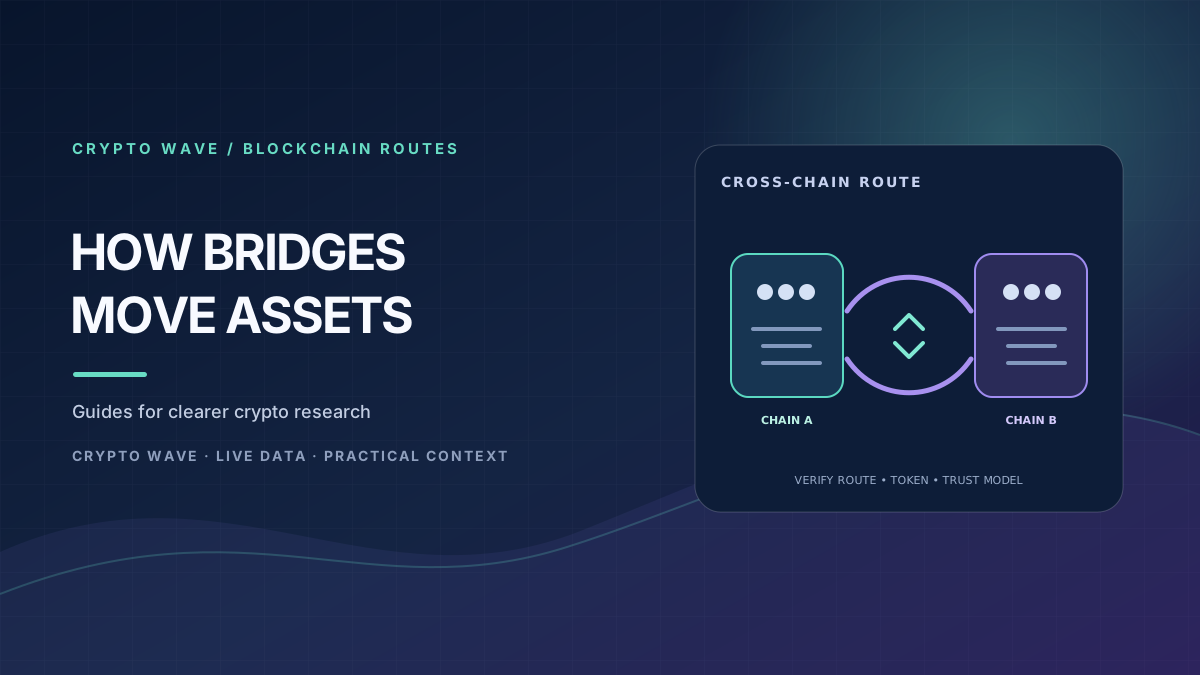
Each blockchain maintains its own state and rules. A token on Ethereum is not automatically available on another network just because both chains support similar smart contracts. A bridge coordinates activity on both sides so a user can obtain a corresponding asset or trigger an action on the destination chain.
Assets are not literally carried from one ledger to another. Depending on the design, the source asset may be locked while a token representing it is issued elsewhere, burned on the source before being issued on the destination, or exchanged through liquidity providers. Some systems also relay arbitrary messages or contract instructions instead of only tokens. Ethereum.org’s bridge documentation outlines common designs and trade-offs.
How cross-chain transfers work
A typical transfer begins when a user submits a transaction on the source chain. A bridge or its watchers detect that transaction and wait for the source chain’s required confirmation or finality conditions. The bridge then verifies or attests to the event and triggers an action on the destination chain. Depending on the route, a destination contract may release tokens, mint a representation, or deliver an asset supplied by a liquidity provider.
That sequence is not identical for every bridge. A lock-and-mint design holds an asset on one chain and issues a corresponding token on another. A burn-and-mint design destroys tokens on the source and issues new ones on the destination, subject to the issuer’s rules. Liquidity-based routes may send destination funds quickly and settle the providers’ positions separately. A bridge aggregator may compare or combine routes, but the selected route still relies on the underlying bridge, contracts, and liquidity.
Bridge types and trust assumptions
A chain’s canonical bridge is generally designed for that chain or rollup and may have specific withdrawal queues, proof systems, or operating rules. Other bridges use external validators, oracle networks, multisignature signers, relayers, or liquidity providers. Messaging protocols may use their own verification networks. Some designs combine several approaches. “Trust-minimized” describes an attempt to reduce reliance on a central operator; it does not mean that a bridge has no extra assumptions or failure modes.
Ask who confirms a source event, who can pause or upgrade contracts, and what happens if a verifier is unavailable or compromised. For a rollup, check whether the bridge depends on a challenge period or proof-verification process. A faster route may rely on a liquidity provider or a different confirmation scheme. Circle’s CCTP documentation, for example, describes an issuer-operated burn-and-mint route for supported USDC transfers. Chainlink’s CCIP documentation describes a separate cross-chain messaging and token-transfer system. These are examples of distinct designs, not endorsements.
Costs, speed and the asset you receive
Estimate the total route cost: source-chain gas, bridge or service fees, destination-chain gas, any swap fee, and the difference between quoted and received amounts. A route can require more than one transaction. Congestion, confirmation thresholds, liquidity, or a bridge’s operating state can affect how long the process takes. A quote shown before signing is not a guarantee of execution time or final output.
Check the destination token’s exact contract address and issuer or backing model. A wrapped token can depend on the bridge’s reserves, custodians, validators, or redemption process. Similar tickers do not prove two tokens are interchangeable. An asset with a familiar symbol on the destination chain may represent a different contract or claim than the native token.
Risks to understand before bridging
Bridge risk includes smart-contract bugs, compromised keys, validator collusion, faulty message verification, governance or upgrade errors, and outages. A wrapped asset may lose its expected relationship to the original asset if backing or redemption fails. The destination chain may have separate consensus or security assumptions. Even if each chain is operating normally, the connection between them can fail.
Users also face operational risk: a wrong destination, unsupported token, incorrect network, fake bridge website, or signature granting broader permissions than expected. An aggregator can simplify route selection, but it does not remove risk from bridge contracts or token issuers in the route. Read the official route instructions, inspect the destination asset, and avoid treating an audit, reserve dashboard, or long operating history as a guarantee.
A practical bridge checklist
- Confirm the source and destination network names and chain IDs.
- Check the token contract and whether it is native, wrapped, or issuer-managed.
- Identify the verification model, upgrade authority, and pause controls.
- Compare the final output after fees, not just the advertised bridge fee.
- Review the estimated time, required confirmations, and withdrawal process.
- Use the official application URL and verify every wallet prompt.
- Start with a small transfer when testing an unfamiliar route.
- Keep the source transaction ID and track the transfer through official tools.
CryptoWave’s DeFi overview and DEX pools explorer can help with ecosystem research. For safe wallet setup and recovery, see our crypto wallet selection guide. If the route includes an exchange account, our wallet-versus-exchange guide explains the custody distinction. Verify current network support with the bridge and token issuer before acting. This article is educational, not individualized financial or security advice.