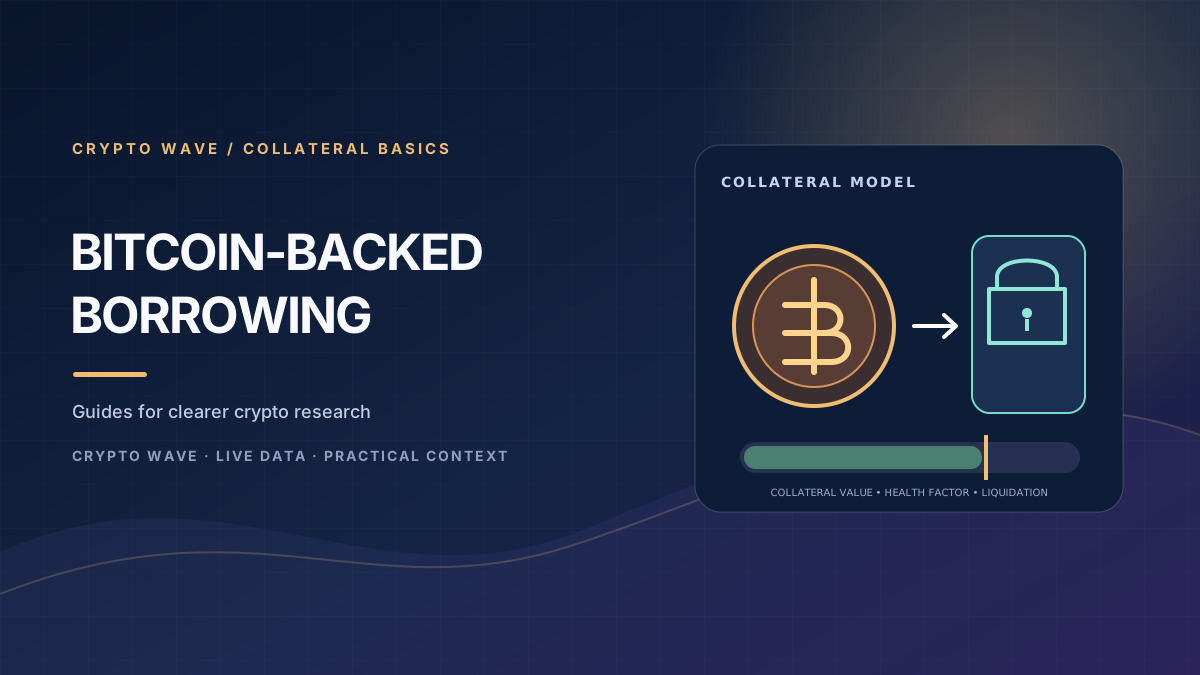
A Bitcoin-backed stablecoin loan lets a borrower access a dollar-pegged token while pledging Bitcoin or a Bitcoin-linked asset as collateral. “Bitcoin-backed” describes the collateral, not a promise that the loan is risk-free or that the stablecoin itself is backed by Bitcoin. The structure matters: a lender may hold BTC directly, while an on-chain protocol usually needs BTC represented or locked in a form its contracts can use.
What is a Bitcoin-backed stablecoin loan?
The borrower deposits collateral and receives a stablecoin loan. The debt must be repaid according to the lender’s or protocol’s terms to release the collateral. A centralized lender may custody BTC and issue credit through an account. A DeFi lending protocol may lock a supported token in a smart contract and let the borrower draw or borrow a stablecoin against it.
Stablecoins are designed to track a reference value, often a currency such as the US dollar, but the peg can move and their redemption and reserve arrangements differ. The loan’s debt is therefore denominated in the stablecoin, while collateral value can change with Bitcoin’s market price. Review both assets and the legal or technical mechanism that connects them.
How Bitcoin becomes usable as collateral
Bitcoin on its native network cannot be directly deposited into an Ethereum lending contract as if it were an Ethereum token. Some lending arrangements use a wrapped or tokenized BTC representation on a smart-contract chain. Other systems use a sidechain or a bridge-like peg that converts BTC into a supported representation. Each design has its own custody, redemption, software, and network assumptions.
For example, WBTC’s documentation describes a tokenized Bitcoin model involving custodians and merchants that handle minting and redemption. Sovryn’s documentation for its Zero protocol describes using BTC transferred to Rootstock as RBTC collateral. These examples illustrate different paths; they are not endorsements or a complete list. Before depositing, identify the exact token contract or network representation and how, when, and by whom it can be redeemed into BTC.
Loan-to-value, collateral ratios and liquidation
A protocol sets limits on how much debt can be issued against collateral. Loan-to-value (LTV) compares the debt value with the collateral value. A lower starting LTV leaves more room for a price decline, but it does not eliminate liquidation risk. Rates, collateral factors, liquidation thresholds, and fees vary by market and can change under governance or lender policy.
Consider an illustrative position with $10,000 worth of BTC-linked collateral and $3,000 of stablecoin debt. Its starting LTV is 30%. If collateral value falls while debt remains, the ratio rises; accrued interest or fees may also increase what is owed. The protocol can make a position eligible for liquidation at a threshold set by its rules. A liquidator may repay some debt and receive collateral with a protocol-defined incentive or discount.
Liquidation mechanics differ. Some systems permit partial liquidation; others may close more of a position under certain conditions. Network congestion, oracle updates, price gaps, or insufficient liquidity can affect how an owner responds. Aave’s official health factor and liquidation guide explains those mechanics for Aave markets; its parameters should not be assumed to apply to another protocol.
Costs, repayment and stablecoin exposure
Compare the complete borrowing cost: interest or variable borrow rate, one-time origination or borrowing fees, network gas, conversion and bridge costs, and any repayment or withdrawal fee. A product advertised as zero-interest may still charge a one-time fee or require other transactions. A variable rate can rise as demand for borrowing changes. Read how interest accrues and whether the stated rate is fixed, floating, or conditional.
Repayment also depends on having the right stablecoin on the right network, plus enough native network token to submit transactions where gas is required. A stablecoin can trade away from its target value, which may make it harder or more expensive to obtain the amount needed for repayment. Check liquidity and repayment routes in advance instead of assuming a stablecoin can always be exchanged one-for-one.
Risks beyond Bitcoin’s price
Bitcoin volatility can push collateral toward liquidation quickly. If collateral is wrapped or bridged, users also depend on the token’s backing, custody, redemption route, or bridge security. On-chain borrowers face smart-contract bugs, oracle failures, governance changes, upgrade permissions, and chain outages. A custodian-based lender adds counterparty, account-access, and contract risks that differ from a self-custody protocol.
Collateralized borrowing is not the same as selling BTC. A loan creates repayment obligations and can result in collateral being sold or transferred if rules are breached. Do not assume that a dashboard health metric is a guarantee: it may depend on oracle prices and protocol settings, and it cannot represent every operational risk. Understand what happens if BTC falls sharply, the stablecoin loses its peg, or you cannot access the platform when you need to repay or add collateral.
Before opening a position
- Confirm whether the collateral is native BTC, wrapped BTC, or a sidechain representation.
- Read the custody, minting, redemption, and supported-network documentation.
- Check LTV, liquidation threshold, liquidation incentive, and how debt accrues.
- Model a substantial BTC price decline and the cost of adding collateral or repaying.
- Verify the stablecoin’s issuer, redemption terms, liquidity, and network contract.
- Include origination, borrow, gas, bridge, swap, and withdrawal costs.
- Keep repayment assets and a way to submit transactions available on the correct network.
- Confirm the protocol’s upgrade, pause, oracle, and governance arrangements.
Use CryptoWave’s DeFi overview for market context, and the Bitcoin market page to review current market data. Our wallet directory and custody comparison can help clarify where keys and assets are controlled. Listings and market metrics are not protocol audits or borrowing recommendations. This article is educational, not individualized financial advice.